Monday, October 19, 2020

Pediatric Office Wall Murals

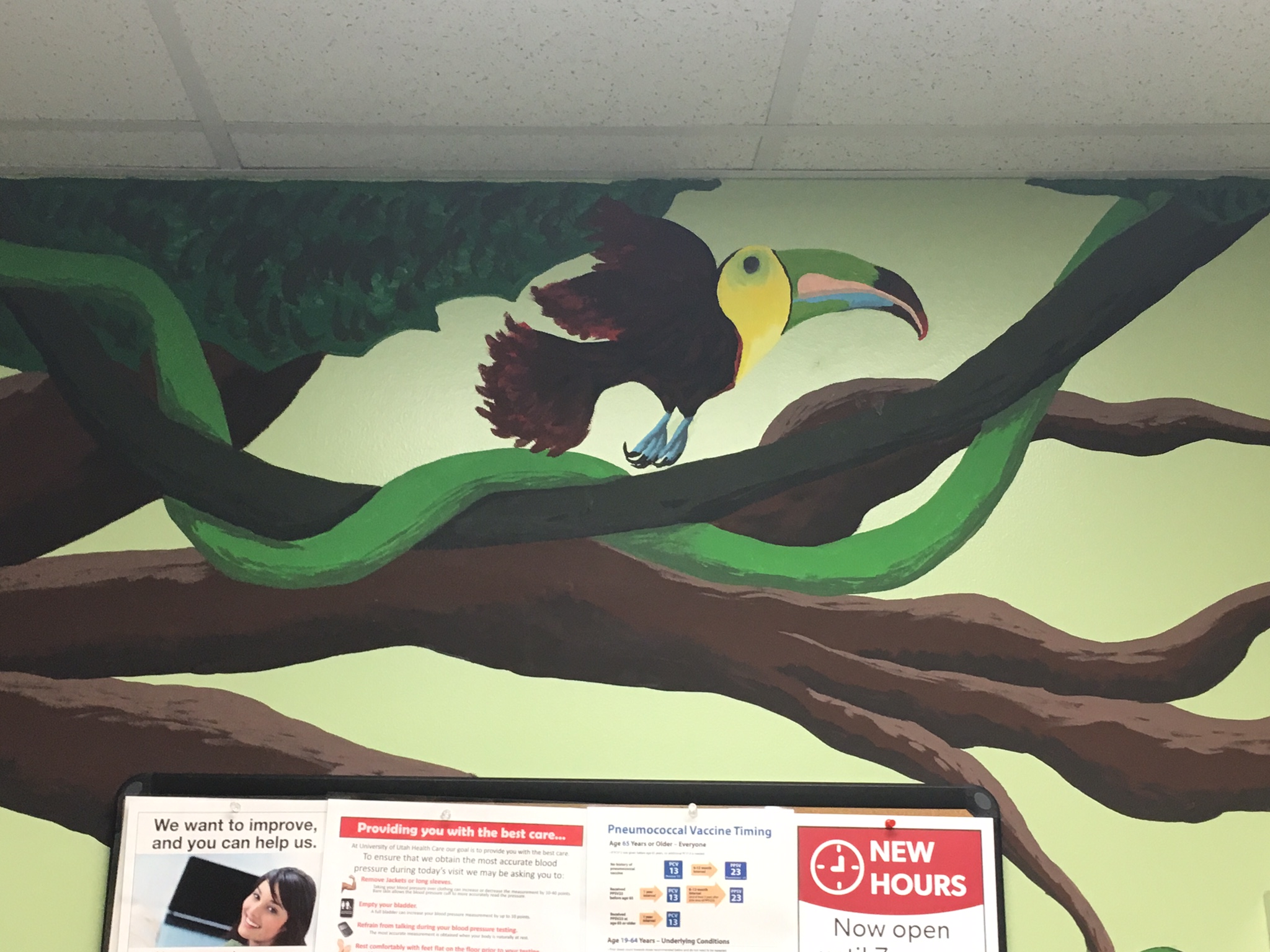
 A while ago my wife had asked me to help her paint her office with some animals. We had worked together each painting a few animals. We started back in 2016 (I believe), then a year later we finally got in there to finish it up. I am rather proud of how it turned out.


The elephant was mine and one of my favorites that I had done.


The giraffe was my wife's and a very cute giraffe it is.


It took about a year between the first and second round of painting. In that time I had done a pencil sketch of this bird, which apparently turned into a game of "find the bird" as some kids noticed the sketch hidden up towards the ceiling.


My wife had also done the lion and the monkey, while I did the trees and the snake. Overall, not too shabby.


Thursday, May 28, 2020

The 306 Greatest Books #164 - If on a winter's night a traveler

The next up on my reading of the 306 greatest books is If on a winter's night a traveler by Italo Calvino. The book can be found on the Observer and My Book Lists.


If on a winter's night a traveler has to be one of the most unique books I have ever read, especially on this list. When thinking about how to categorize the book, I found it very difficult to place it within any category, however if push came to shove I would say that this is a mystery. The mystery for the story is that the main character, often just called the Reader, is trying to find the conclusion of story that he started reading but was missing from the book. During the process he discovers another Reader, whom he teams up with and they end up trying to hunt down the missing text together, only to come across a whole host of uncompleted books. The weird part about the story, is that at times the book is written as if it were talking to us, the audience. But at other times the author treats the book as a book, with the characters acting as one would normally act within a book. It's weird. Chapter one of the book started off so unexpectedly that I had to check a few times to make sure I wasn't reading an introduction:
"You are about to begin reading Italo Calvino's new novel, If on a winter's night a traveler. Relax. Concentrate. Dispel every other thought. Let the world around you fade...."
But after some flipping around the book I soon discovered that, yes, this is indeed how the book is going to go. I thought it was going to be a rather meta reading into the book, when it ends up shifting topics part of the way through, and eventually morphs into that mystery I mentioned. Although it does play with the meta part quite frequently, delving into what you are reading and treating the story as if that is what the Reader is discovering about the book he is hunting for. It feels almost as if this book were written for authors, and that authors would be the ones to get the greatest enjoyment out of it. But otherwise the text was extremely easy to read, at least in the translation I was using. I found I was able to read this book for longer periods of time and at a much faster pace than I am with many of the books on this list. The book was also fairly short, only about 250 pages. So, all in all, a definite recommend, especially for the unconventional nature of the story.  

Thursday, April 16, 2020

The 306 Greatest Books #163 - The Tin Drum

The next up on my reading of the 306 greatest books is The Tin Drum by Günter Grass. The book can be found on the Observer and Norwegian Book Lists.


Upon initially starting The Tin Drum, I had a couple of friends tell me that they really enjoyed the book, so I was looking forward to it. However, the first third of the book was very difficult for me to get into. It could have been the translation, having initially been written in German, but the text didn't really give me much problems. Especially towards the latter 2/3rds of the book. It was the context of the book that I had issues with. The book is essentially a slight supernatural/fantasy book following along a man named Oscar and his family as they grow up through World War 2 in Poland and Germany, although, the war barely plays a backdrop to the book. The story is really about Oscar and his unique abilities, of which there are a few notable ones. The main ability of his that is the namesake of the book was his relentless drumming from the age of 3 onward. The presence or absence of the drum played a pivotal role throughout the story and was essentially how Oscar was able to communicate with other people at times. Although, the most notable is that Oscar decided to stop growing (for the majority of the book) when he was three years old. He wasn't really a "little person" per se, because he never looked any older than a three year old. And although he was a self described genius, he often would act like a three year old at random times throughout the book. After a while this made Oscar not become the "hero" of the story, but a rather self-centered jackass, with less than noble morals. This all made him a not terribly likable character, performing various murders and rapes throughout the book. The prose of the novel was beautifully written but it did not allow for a smooth reading experience, forcing me as the reader, to take my time and read through it carefully. This resulted in being able to only read the book for short snippets of time, because otherwise I would get tired of trying to keep up with it. I actually think this book would be much better as an audiobook, reducing the mental concentration required. Overall, I would say that the story became entertaining, but was frequently frustrating, and I don't think I can recommend this but some people would probably enjoy it.

Wednesday, January 1, 2020

The 306 Greatest Books #162 - Men Without Women

The next up on my reading of the 306 greatest books Men Without Women by Ernest Hemingway. The book can be found on the Observer Book List.


Before coming into this book, I had been a big fan of Hemingway's longer works. This is mainly because they were the first real "literature" I had ever attempted to read on my own, including A Farewell to Arms and For Whom the Bell Tolls. However, I haven't read one of his books in a long time. Men Without Women was the last book of his on any of my lists that I had still left to read and I was confused at first. Apparently, this is a short story collection, and a rather short one at that. I hadn't even realized he had short story collections. In total, the book barely is more than 100 pages long and is comprised of 14 short stories, with two being over 20 pages, making most of the remaining stories 5 to 10 pages long at most. The stories were all written before his longer, more well known works, but most of the stories still seemed to hold the Hemingway style that I had grown to love. His writing style is beyond compare. He is able to draw you into a story very quickly and keep you there with just the beauty of his prose. But since these are some of his earlier works they do feel a bit rougher than his later, more polished works. Within the book, the longer stories are some of the best ones, like "The Undefeated" and "Fifty Grand". His stories clearly are based around situations he knows, like boxing and bull fighting, but I had come to realize something about Hemingway while reading through these stories, as well as reading about the background behind the book. As you can see, the book is titled Men Without Women, and that "without women" part is plainly clear to me now. As I read elsewhere, Hemingway is a great writer, however his focal characters are generally men, and white men at that. Besides white men though, he doesn't do the characters any justice, and in this short story collection, he often just leaves out any, or all, other characters all together. He is also racist and dismissive, and even in one instance it appears homophobic, but the moral of that one story seemed hazy in the end. Overall, I like Hemingway's writing, but I feel these short stories did not age well with the times. I could do without the clearly racist language and undertones, even if they were minor parts of the books, they were still glaring by their inclusion.

Saturday, December 28, 2019

The 306 Greatest Books #161 - To The Lighthouse

The next up on my reading of the 306 greatest books is To The Lighthouse by Virginia Woolf. The book can be found on the Norwegian Book List.


I was initially excited to read To The Lighthouse, mainly because the name of Virginia Woolf has become more popular than her own writing with the popularity of the play Who's Afraid of Virginia Woolf? To The Lighthouse though, turned my expectations very quickly from excited to blasé. At first the book had a very straightforward narrative, but then Woolf would just kind of wander off. It was like trying to keep track of an ADHD kid. One minute she would be on track, following her plot line, but then her thought pattern would be off in a different direction. Eventually she would circle back around and follow up on her initial thread but it made it very difficult for me to follow because when she wandered off, so did my mind. The book is broken up into three sections, with this wandering most noticeable, for me, in the first section. The second part took a dramatic change in tone and style, acting like a fast-forward montage of sorts. The third part then ended up with a similar tone as the first. Eventually, I was able to follow along with the book fairly well and I got pretty invested with the characters. The second section hooked me in. The book, to me, seemed like a push back from the rampant misogynistic attitudes of the day, with the characters having to deal with an overly aggressive (at times) father/husband. The wife, Mrs. Ramsay, is the focal point of the book, despite her not being in the book that much. At times she seems completely aloof, and others, she seems very self-centered, but it is around her which the other characters are drawn to and must learn how to live when she is not around. The most impacted character is Lily Briscoe, a neighbor and burgeoning painter. She ends up being our focal character, through which we see the majority of Mrs. Ramsay's impact. It is an interesting read, and one that would definitely benefit from multiple readings, but in general it feels like the writing style in this this one was not for me.